
Sand Creek Industrial By: Alina Shemetova GEOG 4335 University of Colorado Denver, 2012 Sand Creek Industrial occupies about 500 acres in Denver and Commerce City, Colorado. With an extensive history of industrial use, including pesticide manufacturing, petroleum refining, acidic waste disposal, municipal landfilling, and chemical storage and distribution, a variety of environmental contaminants were discovered and identified at the Site by EPA's Field Investigation Team (FIT was added to the Superfund National Priorities List (NPL) in 1983. It was added to the Superfund National Priorities List (NPL) in 1983, however, after completion of various cleanup cycles completed in1982 under the Comprehensive Environmental Response, Compensation, and Liability Act of 1980 (CERCLA), the site was deleted from the NPL in December 1996. Various parcels of land were sold for redevelopment including a warehouse known as the Matteson Warehouse, a railroad property, and a 56-acre parcel of land known as the Colorado Paint Property. Sources of Contamination at Sand Creek: · The COCC facility - A pesticide manufacturing facility, that operated from the 1960s until 1984 and was cited for unsatisfactory work practices; · The LCC property - Storage and neutralization of spent acidic wastes from a herbicide chemical plant · The Oriental Refinery site - released approximately 48,000 gallons of refined petroleum during a fire in 1955 · The 48th and Holly Landfill - accepted demolition and domestic refuse from 1968 to 1975, and was the site of two methane gas explosions in 1977 Currently, Suncor Energy is in charge of cleanup of the site and about 300 groundwater wells have been drilled around the property and at the wastewater plant to track contamination, with 25 wells capable of recovering liquids. Although groundwater in the area is classified as a potential drinking-water supply by the State of Colorado, there is no unacceptable current health-risk due to ingestion, inhalation, or skin contact with contaminated groundwater since water for residential use is provided through treated water from either the Denver Water Department or the South Adams County Water and Sanitation District, there are still potential risks associated with future use of groundwater for domestic purposes.
|
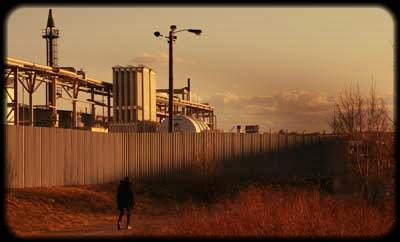 Health Risks: - Soil and ground water at the site were found to be contaminated with volatile organic compounds (VOCs), pesticides, herbicides, and arsenic. - Exposure to such contaminated groundwater or soil could cause serious health problems, such as cancer and damage to the liver, central nervous and respiratory systems. People also could be exposed by inhaling contaminated dust and vapors. Suggested cleanup remedies: • Implementation of institutional controls that will minimize exposure to contaminated groundwater at OU4 by limiting groundwater usage to non-domestic purposes and preventing any usage of highly contaminated groundwater. • Quarterly groundwater and surface water monitoring to evaluate contaminant migration and changes in site conditions. • Removal of the recoverable portion of the LNAPL plume located in the northwest portion of the Site with a dual vapor extraction (DVE) system. Recovered LNAPL will be transported off site to a recycling facility. • Onsite infiltration of treated groundwater removed incidentally by operation of the DVE system. • Five-year site reviews will be conducted at OU4 and additional remedial action will be taken if warranted by a change in site conditions. Suncor Energy has expanded the hose system blowing air bubbles into Sand Creek attempting to expel cancer-causing benzene spreading from under the company's oil refinery north of Denver. Its crews also have been packing a trench with bentonite clay from Wyoming, focused on meeting a deadline for the completion of a 1,000-foot-long, 30-foot-deep underground wall designed to hold back contaminated groundwater. But benzene levels in Sand Creek and the South Platte River remain significantly elevated -- as much as 100 times higher than the U.S. health standard. Three months after state regulators ordered an intensified cleanup, the fouling of northeastern Colorado's main waterway continues. A Denver Post analysis of water sampling data shows that the benzene levels in the creek and river may be increasing. At the confluence of Sand Creek and the South Platte, the latest test results show an average benzene concentration of 460 parts per billion in February, up 29 percent from an average of 356 ppb in December. The average for the past eight samples, taken in January and February, was 511 ppb. The federal drinking-water standard is 5 ppb. Farther downstream, beneath a bike bridge on the South Platte, tests show an average benzene concentration in February of 241 ppb, up nearly 10 percent from 220 ppb in December.
|
