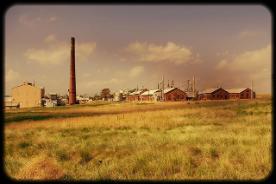
ASARCO
Globe Plant
Another site which is more recent to be added to the superfund list is ASARCO
globe plant. This is located in a mixed use industrial, commercial and
residential area, known as Globeville, near the South Platte River, in Denver
and South Adams County. This was deemed so because of smelting
operations, which separate impurities from gold, silver, copper, and lead began
in 1886.American Smelting and Refining Company (ASARCO) bought the plant
and converted it to a lead only production facility in 1901. In 1919
ASARCO changed from producing lead to arsenic trioxide for use in pesticides,
medicines and glass. The Then in 1926, the company began producing cadmium
production for protective coatings for iron and steel. It finally closed in
November 2006. The smelting operations left elevated levels of cadmium, lead,
arsenic and zinc in groundwater, surface water, sediment and soil near the
plant. This contamination extends as far south as the South Platte River.
This facility is still being cleaned and talks are in order to determine the
best use for this former industrial site, it is currently being cleaned.
|
|
Dumping: Superfund Sites, Brownfield Sites,
Sports Authority Field
By: Che Castor
GEOG 4335
University of Colorado
Denver, 2012
As with many other cities
across the nation and perhaps the world, Denver has had a very industrial past
that propelled it into the industrial age and beyond that into the modern day
economy. However, through all of the industrial sites that produced a
massive amount of products that added to the city’s economy, they also produced
monumental amounts of waste, many which are toxic. Many of these
chemicals and radiation were left at the sites and as they decayed, the
chemicals may have leaked or were neglected, allowing them to escape into the
open environment. These toxins have been absorbed by the soil, carried
away by the local rivers, in this case the South Platte, or have been released
into the air. Because of these hazardous conditions, the EPA along with
the State of Colorado, has restricted access to these sites and have been given
financial support to clean up the contaminants. These sites are commonly
known as Superfund sites, contaminated sites that have yet to be cleaned or
have had a history of contamination and have now been reduced to levels that
make them inhabitable and have been reclaimed.
 |
|
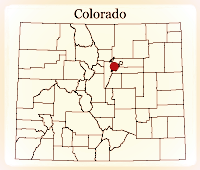
I-70
and Vazquez blvd
Another site that is showing concern is the site at I-70 and Vazquez
blvd. The EPA conducted a five year review of the area and determined
that the area was contaminated with large amounts of lead and cadmium in the
yards of residents. The cleanup was a vast effort that encompassed four
square miles and 4,500 properties in Denver, including Curtis Park, Clayton,
Swansea, and Cole. The EPA took 30 soils at each of the
residence then removed, replaced and re-landscaped at 800 of the properties
because of the lead and arsenic contamination; they removed 91,000 cubic yards
of soil and planted 1.5 million square feet of sod in the effort to clean the
site. This particular superfund site was unique in the fact that it had a
lead abatement program and community based community health program to raise
awareness of the health hazards of the contamination. The source of
the contamination was plants owned by Omaha and Grant Smelter and Argo, which
discarded the waste and left most of it on site. A portion of this site
is where the Denver Coliseum stands today.
|
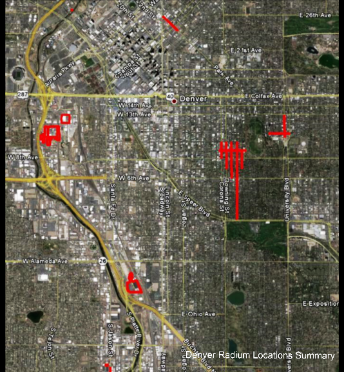
Denver
Radium
Some of these hazardous sites include the Denver radium site. This
site is located in southwest Denver, west of the South Platte River and North
of Ruby Hill Park. It includes several properties, known collectively as
the 1000 West Louisiana Avenue Properties. They cover approximately
11 acres in an area that was previously zoned for industrial use, and contains
about 40 properties along the South Platte that were contaminated as a result
of a radium processing industry that flourished here from 1915 – 1927.
The production of refined radium produced large amounts of radioactive waste
materials, and they were commonly discarded or left on the site when the
facilities were shut down. In 1979 The EPA discovered the presence of the
long forgotten waste materials, and subsequent research discovered 31 radio
logically contaminated properties as a result of the waste. Because of
the enormity and the complexity of the sites, the EPA deemed it a superfund to
be cleaned. Of course dealing with radioactive waste can have dire
consequences depending on the level of exposure to the individual. For
example, much of this waste can cause cancer. In addition, it can pose
neurological problems as well as developmental, developmental problems for
children, and even death. Beginning in 1988, the EPA
excavated almost 97,000 tons of radioactive soil and materials, demolished and
removed the buildings, and shipped the contaminated materials to an “EPA
approved facility equipped to handle the waste. In addition to the
radioactive materials they uncovered heavy metals such as arsenic and
cadmium. They placed a protective cap to limit exposure and prevent the
metals from migrating.
|
