How has water development affected water quality in the South Platte River Basin?• Withdrawals of large volumes of water from streams in the basin for agricultural and urban use result in less water to dilute contaminants in streams. • Alteration of the natural flow regime has degraded native aquatic habitat along streams. • Ground water (subsurface irrigation return flow) is a major nonpoint source of nitrate, dissolved solids, and pesticides (atrazine and prometon) in the lower reaches of the South Platte River. • Reuse of surface and ground water for irrigation has resulted in increased salinity in the lower South Platte River and surrounding alluvial aquifer. High salinity can be detrimental to irrigation and drinking-water supplies. • Stream water having high concentrations of nitrate can be stored in agricultural reservoirs, where nitrate concentrations decrease during the summer; thus, reservoirs could be part of a nitrate management strategy.
|
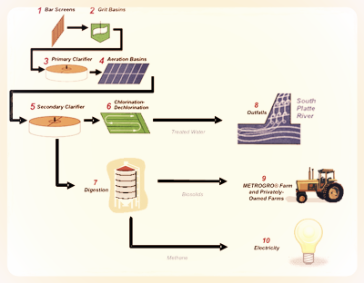
Water Quality: Water quality testing along the river metro Waste Water Treatment FacilityBy: Sam Epperly GEOG 4335 University of Colorado Denver, 2012 Waste Water to Water Treatment Steps:1. Bar screens remove objects ranging from children's toys to false teeth. 2. Grit basins remove larger solid wastes. 3. Primary clarifiers remove smaller solid wastes. 4. Aeration basins enable millions of microorganisms to digest the organic waste remaining in the water. 5. Secondary clarifiers allow the microorganisms clump together and settle to the bottom. After further processing to kill harmful organisms, these biosolids will go to enrich Colorado farmland. 6. Chlorination and de-chlorination processes provides final wastewater treatment. 7. Digestion involves anaerobic digestion by microbes of solids into biosolids and methane. 8. Outfalls are where the cleaned wastewater pours into the South Platte River. 9. Biosolids (our brand is METROGRO® ) are applied to our METROGRO Farm and privately-owned farms and incorporated into the soil either by tilling or applying them to the soil surface depending on the land's slope or erosion potential. 10. Methane gas from the digestion process is used to generate electricity at our facility
|

